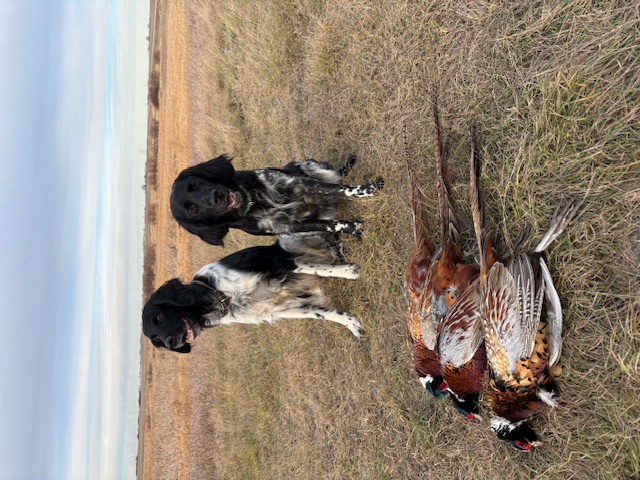
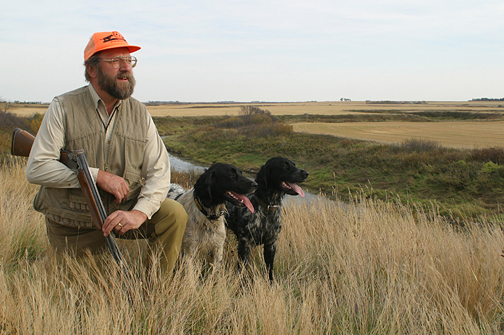
In addition to Lux’s age-appropriate versatile exposure there was good breeding. Lux evidently inherited good field ability and cooperation. This came not only from her parents but was backed up by a pedigree full of performance-qualified ancestors. The consistent breeding of full versatile ability to mates with the same qualities proven by trained judges is what geneticists suggest, including Malcolm B. Willis (The Domestic Dog, Cambridge). This approach, when maintained over generations, leads to stability of heritable characters in all types of working dogs. And, it leads to amazing outcomes.
Lux went hunting a week later in the same area. As we approached a sizable patch of native-prairie with cattail ponds, Lux suddenly froze into a point in the snowy stubble. The ½ dozen pheasants she pointed were 50-75 m away. On our arrival, they walked from their food scratches in the canola stubble back into native grass and snowberries. Lux’s brother Loki and Asio were outside the scent cone. Both backed Lux’s point staunchly taking her cue. As Brent, Rick and I walked ahead they stayed staunch. Not wanting the dogs to break point on their own, I decided to release their point with an encouraging “OK.” This sent them running and the pheasants flying. The rest of Lux’s work was as amazing as it started.
Praise be to capable hunting dogs and to the pheasants they help us put in the bag!
Past Performance
Thirty-five litters were born at the Sunnynook Kennel since it began in 1977. By 2017, 208 pups were weaned.
Fifty-five of the 121 pups born in the first 20 litters have been tested in Natural Ability (47%) and 41 of these passed (74%). There are also 6 which went on to pass UPT of
10 run and 11 of 17 passed the Utility test. This speaks well not only of the pups but also of the excellent handlers and homes they found themselves in.
For more information about the LMs that currently live at Sunnynook.
Registration and Proof of Performance
Every Sunnynook puppy born through 2015, is tattooed and comes with a performance-annotated pedigree endorsed by the Large Munsterlander Association of Canada . LMAC is incoportated under the Animal Pedigree Act of Canada affording protection to breeders and owners under Canadian law. Furthermore:
- Our own Sunnynook breeding requirements exceed those of LMAC
- We apply our high standard not only to current sires and dams. Through our experience and evidence-based breeding tradition virtually all ancestors on a 3-generation pedigree meet our standards.
~ Abbreviations ~
appearing on LMAC pedigrees are explained in this downloadable pdf document.
Why Large Munsterlanders?
We choose the Large Munsterlander
- for its versatile hunting strengths in upland and water, before and after the shot
- for its handsome and protective coat with a long-tail
- for its intelligent companionship in the home and year-round
Sunnynook Kennel and You
- We invite potential owners to meet our dogs and hunt with us where possible.
- We engage prospective owners in conversation to explore what an owner is looking for in a dog and what we think we can provide. Inviting a puppy into a home can be a life-changing decision.
- Once our puppies are in their new home, we hope to stay in touch with the owners. We welcome owner participation in training events and ultimately to become participants in breed maintenance.
Breeding Goals - a matter of balance
- Dogs that are in control of their otherwise-strong desire to hunt.
- Ranging wide when cover encourages it - yet wanting to hunt with and for the owner.
- Good work ethic and also able to bide time quietly in the home.
- Healthy genetically and good immunity from raw diet.
- Companionable with people and other dogs.
- Conforms to standard - low on showiness and high field functionality.
Guarantees
All our dogs and at least 30 of their ancestors are field qualified and free of hip dysplasia (see pedigree). Hunting ability and health is part training/upbringing/food and part genetics. Still, it may happen that a pup does not develop according to our expectation as a hunter, in which case we take the dog back for purchase-price refund or replacement. We guarantee hunting ability and health, not necessarily a dog with automatic breeding potential.
Placement Policy
We ask that owners come to pick up their pups. We do not fly pups alone. In some cases a flight by the owner and the pup in the cabin is actually not as expensive as flying a pup alone in the luggage compartment.
We place dogs only with hunters who expect to train and use the dogs for bird hunting. There are three reasons: 1) Hunters may field test or at least report on the hunting abilities of their dogs from our kennel. This helps us decide on the breeding value of parents for future breeding decisions. 2) Hunting is in the dogs' nature, it can endanger the dog and other wildlife if not appropriately channeled and controlled. 3) The nearly 400 dog breeds in the world are designed for specific and subtly different uses. Hunting and pure companionship make different demands on a dog and on a breeder. We encourage our owners to breed in turn if their dog is exceptional as a hunter. However, we resist having this selection diluted by other (show or companion) interests.
In our experience a puppy's upbringing involves a series of stages that start at different times and are overlapping. This is roughly as follows:
| 0 - 1 1/2 months |
Pups simply grow and become weaned.
|
| 1 1/2 - 6 months |
Learn to hunt through play that needs to be frequent, brief and enjoyable (wing-on-a-stick, toy retrieves).
|
| 3 - 24 months |
Learn manners (in the home, vehicle & kennel, with people and other dogs)
|
| 6 - 18 months |
Gradual exposure to wild birds, water, retrieving & tracking. Introduction to the shot. This is also a good time for an owner to consider entering the pup in one of several natural-ability-type tests, for an objective evaluation on which areas to stress in future training/exposure, and to provide feedback to the breeder on his/her success and future direction. |
| 10 - 24 months |
Gradually increasing insistence on manners on birds through obedience training. At the end of this period is a good time to decide whether the dog would make a positive contribution to the Large Munsterlander breeding pool. |
|
8 - 36 months |
Hunting exposure and experience. |
On any of these, we would be pleased to provide advice. The result should be a hunting dog that is a joy to be with, in and out of the hunting season.
We have provided each owner with a copy of "Training and care of the versatile hunting dog", the classic manual for versatile dogs. This manual is short and specific in its instructions. Other books can amplify these sections. Among them, is an excellent book written by Joan Bailey, entitled "How to help gun dogs train themselves". This title is not just an empty promise. Joan Bailey provides excellent tips about how to make everyday things into learning opportunities for a pup. Look for the book at http://www.swanvalleypress.com.

A brief description of Wing-on-a-stick play. This is a great game to build passion, capacity and a work ethic, but a few words of advice are in order. Make sessions short and rewarding for the pup. Don't treat it as a substitute for wild birds. By six months, the game should transition into work with wild birds. The wing can be replaced with a dummy and the dog can learn manners and commands, but sight pointing should be replaced by opportunities to point scent by then.
For the play, keep in mind that pointing is the exaggerated stop-before-the-pounce of wild canines. Build some excitement first by a few chases and then encourage pointing. End the chase by lifting the wing high. When the pup stands and looks at it, lower it gently. Sometimes a sudden drop triggers a strong point - learn to read your dog, and reward it for the slightest progress. The reward is catching the wing, not by the pup pursuing it but by the owner moving it to within the standing pup's reach. Early on, a pup may be rewarded for standing while the wing is lowered from 1 to 1/2 m in the air, about an equal distance away. Later, the pup needs to stand while the wing rests on the ground for the pup to be rewarded, but be sure to end each session with a reward.
Allow the pup to hold and pull on the wing, praising all the while. Relaxing on the string and then tugging gently can cause the 'bird to escape' again. If the pup has too firm a grip, build trust by picking the pup up and taking away the wing gently, or trading the wing for food or another item the pup wants. After the session, put the wing out of sight. Do not allow prolonged chewing. These sessions are very useful for an owner to learn about the pup's nature, does drive need to be boosted or does the pup have lots of it. These play sessions build rapport. Thought and care should be used in the game, study the pups reactions and respond accordingly for best success - remember, they are still "toddlers".
A bit about us.....
|
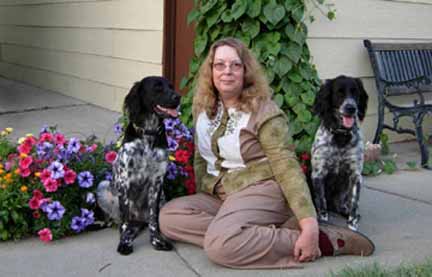
Sheila helps train the dogs and is actively involved in whelping, etc. but leaves the real hunting to the rest of the family. Sheila retired in 2016 as genetics professor at the University of Saskatchewan. She often used her own dogs teaching examples in both the genetics course she taught and the course of dogs and cats she developed. One of Sheila's research areas is the genetics of coat color in dogs. One of her hobbies is sewing, especially with fur. Sora is on her left and Pika on her right.
|
 |
For more information on the Large Munsterlander in Canada
Please call us if you have any specific questions (306)382-8964. e-mail
josefkschmutz@gmail.com or e-mail
sheila.schmutz@usask.ca